

The global job market stands at a pivotal moment. While employment rates are near historical lows in many regions, several structural shifts, from technology and green transitions to demographic change and global supply-chain realignment, are profoundly reshaping the world of work. For job-seekers, career-movers, and international applicants, understanding these forces is the first step to navigating success.
Global Employment Landscape
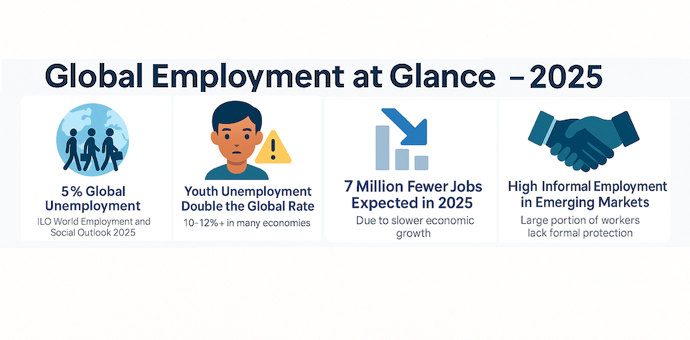
According to the ILO’s “World Employment and Social Outlook Trends 2025” report, the global unemployment rate remains near historic lows, about 5% in 2024-25. Yet, beneath this headline lies a complex story: youth unemployment remains far higher (often 10-12%+ in many economies), and many roles are underemployed or informal. Simultaneously, the ILO flags a weaker job-growth outlook, estimating up to 7 million fewer jobs in 2025 than previously expected. International Labour Organization.
Major Drivers of Change
1. Technology & Automation
The WEF’s “Future of Jobs Report 2025” highlights technological change, including AI, automation, and digitalization, as key forces shaping labour markets globally through to 2030. World Economic Forum – Global Competitiveness Report
For example, the report notes that of the professions surveyed, roles such as farm-workers (driven by green transition) and software developers are projected for growth—while many existing roles face transformation or decline. World Economic Forum
2. Skills & Mismatches
Employers increasingly seek workers with new skill-sets. The WEF reports that over 70% of companies expect to hire people with significantly different skills than today. World Economic Forum
Meanwhile, the ILO identifies that up to one in four jobs could be “transformed” by generative-AI technologies in the coming years. International Labour Organization
3. Green Transition & Sectoral Shifts
The push to decarbonize economies is creating new jobs (e.g., in renewable energy, sustainable agriculture) even while reducing demand in older fossil-fuel and high-carbon sectors. The WEF projects tens of millions of new roles by 2030 linked to the green transition. World Economic Forum
What This Means for Individuals
- Be active, not passive. Generic resumes and one-size-fit-all approaches no longer suffice. Job-seekers must tailor their credentials, highlight transferable skills, and show agility.
- Upskilling and reskilling matter. Given rapid change, workers who learn new skills and adapt will be better positioned.
- Flexibility pays off. Careers will increasingly span multiple industries, geographies, and job-types, not just linear paths.
- Global context matters. International job-seekers must understand localized norms, visa/regulatory environments, and cross-border competition.
Conclusion
The job market today is dynamic and full of opportunity, but also full of risk for those who remain passive. By staying informed about the driving trends and adapting accordingly, individuals can position themselves for success regardless of how the future evolves.