
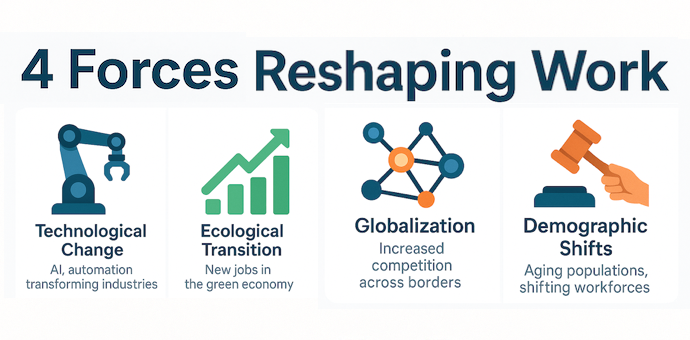

Looking ahead to 2030, workforce transformation promises both disruption and rare opportunity. With the majority of workers currently in roles that will evolve significantly, planning proactively is essential. The WEF and ILO provide a roadmap of where work is heading and how to stay ahead.
Forecasted Job Market by 2030
The WEF’s 2025 Future of Jobs report estimates that changes stemming from technology, green transition and demographic shifts will reshape large portions of the workforce by 2030. Global Competitiveness Report. Among the fastest-growing occupations are software & applications developers, big-data specialists, and roles in climate mitigation. Conversely, many routine roles face decline. World Economic Forum
Meanwhile, the ILO warns that, while automation will transform many jobs, the focus must remain on job transformation rather than purely job loss: about one-quarter of jobs may be heavily impacted. International Labour Organization
Skills Will Be the New Currency
The trend is clear: skills matter more than ever. Employers are looking for digital literacy, adaptability, critical thinking, creativity and human–machine collaboration. The WEF reports that nearly 40% of core skills will change in the next five years. World Economic Forum
For example, “Transferable skills” such as leadership, communication, and resilience are becoming indispensable as automation takes over routine tasks.
New Models of Career Mobility
A. Industry Pivots
Workers will increasingly pivot from one industry to another (e.g., manufacturing → data-analytics) rather than just climb within the same field.
B. Global Opportunities
Cross-border work, remote roles, and digital nomadism will become more common, accentuating the importance of localization, remote-first skills, and cultural competence.
C. Lifelong Learning
Continuous learning will not be optional, it will be essential. Micro-credentials, online boot-camps, and modular learning pathways will complement traditional degrees.
Implications for Hiring and Job Seekers
- Resume-making will change. ATS tools, AI-agents and semantic matching will become standard. Simply listing skills won’t cut it; contextual evidence will.
- Fit and matching matter. Workers will need to demonstrate fit not only for a role, but for the culture, tech-stack, and industry dynamics.
- Localization & personalization will matter for international job-seekers; one size no longer fits all.
- Career platforms will evolve. Tools that help with job matching, tailor resumes, and highlight transferable skills will become powerful enablers.
What You Can Do Right Now
- Audit your skills every 6 months: what’s out-of-date? what’s becoming critical?
- Build a modular “career kit”: resume, cover-letter variants, portfolio/LinkedIn version.
- Choose one “pivot optionality”: a field where you could move to if your current industry changes.
- Stay globally aware: understand immigration/remote-work trends in high-growth markets.
- Use AI-tools not just to automate tasks but to augment your professional brand.
Conclusion
The future of work doesn’t belong to those who wait, it belongs to those who adapt. By understanding the major trends, building skills proactively, and positioning for mobility, you’ll stand out in a workforce defined by change.